Content
A Rotary Unwinder is applied in any industrial process where a continuous web material -- paper, film, foil, fabric, or nonwoven -- is wound onto a roll and must be fed at a controlled, consistent tension into a downstream converting, printing, laminating, or packaging line. The primary applications span label printing, flexible packaging, corrugated board production, tissue and hygiene manufacturing, nonwoven fabric converting, technical tape slitting, and continuous forms printing -- industries where uninterrupted web feed and stable tension directly determine product quality and line productivity. This article examines each application category in technical depth, with the specific operational demands that make a rotary unwinder the correct equipment choice in each case.
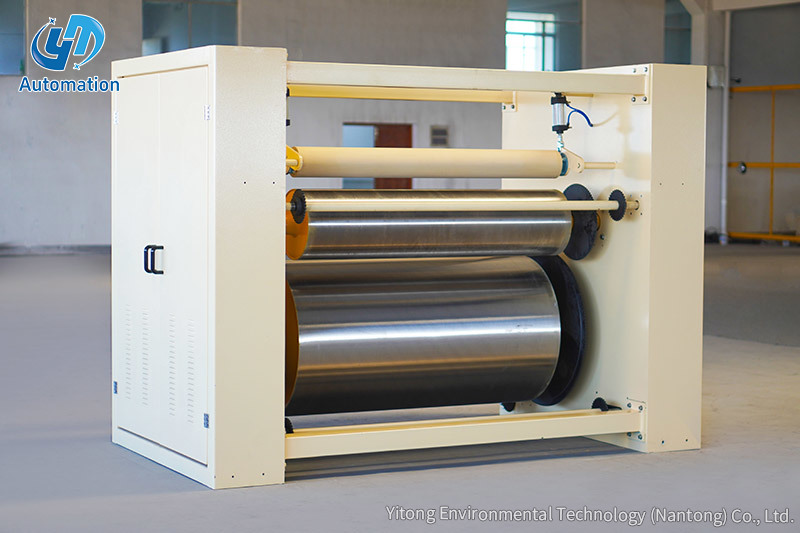
Before examining applications, it is important to understand precisely what a rotary unwinder contributes to a production line that a simple passive roll-off stand cannot. A rotary unwinder is a powered, tension-controlled roll feeding system in which the roll mandrel is actively driven -- either by a servo motor, torque motor, or regenerative braking system -- so that the speed and torque of roll rotation are continuously managed as the roll diameter decreases from full to empty.
This active control solves three problems that passive roll stands cannot address:
These capabilities are what make a rotary unwinder essential rather than optional in any high-speed or precision web converting application.
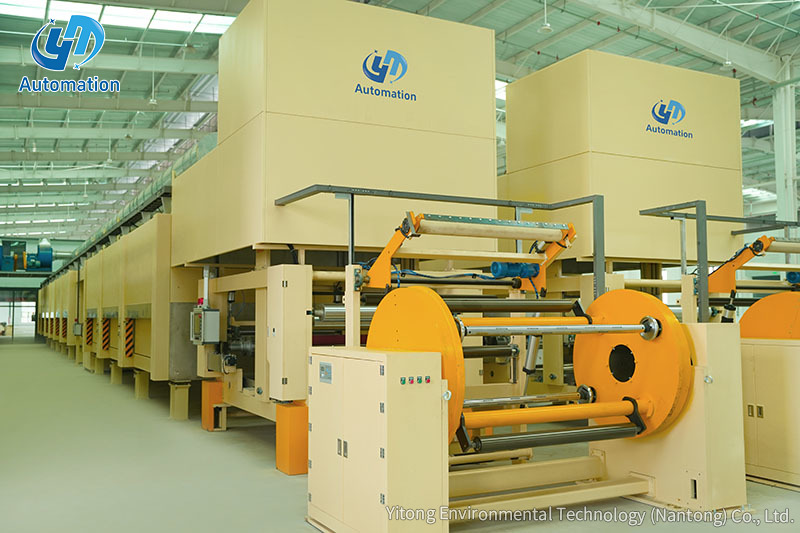
Label printing is one of the highest-volume applications for rotary unwinders globally. Pressure-sensitive label stock -- a composite web of face material, adhesive, and release liner -- is printed on narrow-web flexographic, offset, or digital presses running at speeds of 100 to 300 meters per minute. At these speeds, even a brief tension fluctuation causes color-to-color misregister that exceeds the tolerance specification (typically 0.1 to 0.2 mm for pharmaceutical labels) and results in press stops and material waste.
Rotary unwinders in label press applications must handle rolls of face stock, liner, and laminate materials ranging from 25 to 600 mm in width and roll diameters up to 1,000 mm or more. The adhesive-coated underside of label stock is particularly sensitive to tension variation -- excess tension stretches the elastic face material and changes the die-cut dimensions; insufficient tension causes web flutter that misaligns the label relative to the die station.
Modern label press installations commonly use double-shaft or turret rotary unwinders that allow a new roll to be pre-loaded on a second mandrel while the current roll is running, enabling a flying splice -- an automatic web join at full press speed that eliminates the production stop otherwise required for a roll change. Flying splice capability at 200 m/min requires the rotary unwinder's control system to accelerate the new roll to precisely match running web speed within 0.1 to 0.5 seconds before the splice tape engages (source: FINAT Technical Bulletin, Narrow Web Converting Technology, 2021).
| Label Application Type | Web Width Range | Typical Line Speed | Key Unwinder Requirement |
| Pharmaceutical / medical labels | 40-160 mm | 50-150 m/min | Tension accuracy within plus or minus 2%; register within 0.1 mm |
| Food and beverage labels | 80-330 mm | 100-300 m/min | Flying splice; high-speed tension control; wide roll diameter range |
| In-mold labels | 150-520 mm | 60-120 m/min | Handling of thin polypropylene film (25-60 micron); low tension capability |
| Linerless labels | 50-160 mm | 80-200 m/min | Silicone-coated web handling without blocking or adhesive transfer to mandrel |
Speed and width ranges sourced from FINAT Technical Bulletin, Narrow Web Converting Technology, 2021. Register tolerance per pharmaceutical industry standard ISO 11607.
Flexible packaging -- the pouches, bags, sachets, wrappers, and laminates used for food, personal care, and household products -- is manufactured on wide-web gravure or flexographic printing lines, laminating machines, and form-fill-seal systems that operate at 150 to 600 meters per minute. Roll weights in flexible packaging converting routinely reach 800 to 2,000 kg, and roll diameters of 1,200 mm are common in wide-web operations (source: Packaging Europe, Flexible Packaging Converting Technology Report, 2022).
The unwinding challenge in flexible packaging is threefold. First, the substrate variety is extreme -- the same production facility may run 12-micron aluminum foil, 15-micron BOPET film, 200-micron PE foam, and 80 gsm paper in the same week, each requiring different tension setpoints and different unwinder speed-torque profiles. Second, the high roll weights demand unwinders with robust mechanical designs -- cantilever mandrel loads of 1,500 kg or more require precision-engineered bearing assemblies and heavy-duty frames. Third, multi-layer laminate structures require precise tension control during both the printing pass and the laminating pass to avoid adhesion defects caused by wrinkles or tension mismatch between layers.
Gravure printing lines for flexible packaging -- the highest-speed application in the category -- require rotary unwinders with dancer-roll tension control systems that can respond to tension variations within 50 to 100 milliseconds to maintain register accuracy across 8 to 12 color stations over print repeat lengths of 300 to 800 mm (source: Gravure Association of Europe, Technical Handbook, 2020).
Corrugated board manufacturing lines -- corrugators -- are among the widest and fastest web processing machines in the paper converting industry. A single corrugator handles multiple web streams simultaneously: the fluting medium (corrugated inner layer) and one or two liner webs (flat outer layers), all running at speeds of 200 to 400 meters per minute at web widths of 1,800 to 2,800 mm.
Each web stream requires its own rotary unwinder. A standard double-face corrugator line uses three to five rotary unwinders operating simultaneously, and the tension relationship between the liner and fluting webs determines the flatness, caliper, and compression strength of the finished board. Tension mismatches between web streams produce warp -- the bowing of finished corrugated board that causes jamming in box-making machinery downstream and rejection at quality inspection.
Rotary unwinders in corrugator applications must also manage the splicer integration -- each unwinder is paired with a splicer that joins the tail of an expiring roll to the leading edge of a new roll at full line speed. Corrugator splicers typically use a butt-splice method (zero-tail splice) that requires the incoming roll to be accelerated to line speed and held within plus or minus 0.5% of line speed before splice engagement to ensure a clean, gap-free joint that does not cause a board defect at the splice point.
Source: FEFCO Technical Handbook, Corrugated Board Manufacturing, 2021.
Tissue paper and hygiene product manufacturing -- facial tissue, toilet roll, kitchen towel, and wet wipes -- involves unwinding large parent rolls (tambours or jumbo rolls) of tissue or nonwoven web into converting lines that emboss, fold, cut, and package the finished product. Parent rolls in tissue converting typically measure 2,000 to 5,000 mm in width and up to 3,000 mm in diameter, with web weights as low as 12 to 40 gsm -- making tissue one of the most challenging web handling applications due to the extreme combination of very large roll dimensions and very low web tensile strength.
Because tissue web can break at web tensions as low as 2 to 5 N/m of width, the rotary unwinder must maintain tension with exceptional accuracy -- a tension spike that would be inconsequential on a packaging film line would break a tissue web instantly. Tissue converting lines therefore use rotary unwinders with closed-loop load cell tension control rather than dancer-based tension control, because load cells provide faster and more precise tension measurement with the very low tension forces involved (source: INDA, Nonwovens and Tissue Converting Technology Primer, 2020).
Wet wipe manufacturing adds the additional complexity of handling nonwoven fabric -- typically spunlaced or airlaid material at 30 to 80 gsm -- that has lower stiffness than tissue paper and is more prone to edge waviness and lateral drift during unwinding. Rotary unwinders in wet wipe converting lines incorporate edge-guided steering systems -- servo-driven lateral actuators that continuously reposition the entire unwinder frame to keep the web edge at a fixed lateral position, preventing the edge drift that would cause misalignment in the folding and cutting stations downstream.
Nonwoven fabrics -- spunbond, meltblown, spunlaced, needlepunched, and thermobonded materials -- are used in medical disposables, filtration media, geotextiles, automotive interior components, and construction membranes. Converting these materials into finished products involves processes including slitting, laminating, printing, die-cutting, and ultrasonic bonding, all of which require a controlled web feed from a roll.
Nonwoven converting presents unwinding challenges that differ significantly from paper or film applications. Nonwoven fabrics have significantly lower modulus of elasticity than paper or polymer films, meaning they stretch more readily under applied tension. This elasticity means that tension control must be more dynamic -- the unwinder's control loop must respond faster to prevent tension variation from propagating into the fabric as width variation (necking) that would cause dimensional defects in the finished product.
Medical nonwoven converting -- surgical drape stock, isolation gown material, and filtration media for respiratory protection -- operates under cleanroom or controlled-environment conditions that impose additional equipment requirements. Rotary unwinders in these applications must be constructed of materials that do not generate particulate contamination, be cleanable with isopropanol or other approved sanitizing agents, and in some cases be certifiable for operation in ISO Class 7 or Class 8 cleanroom environments.
Our Rotary Unwinder is engineered for the full range of nonwoven converting applications, with tension control systems configurable for the low-tension, high-elasticity characteristics of spunbond and meltblown materials and structural designs available to meet cleanroom compatibility requirements.
| Nonwoven Material Type | Basis Weight Range (gsm) | Typical Tension Range (N/m) | Primary Converting Process |
| Spunbond PP | 10-150 gsm | 5-80 N/m | Hygiene product laminating, medical converting |
| Meltblown PP | 15-60 gsm | 3-20 N/m | Filtration media laminating, mask production |
| Spunlaced (hydroentangled) | 30-120 gsm | 10-60 N/m | Wet wipe converting, medical wipes |
| Needlepunched | 100-800 gsm | 50-300 N/m | Geotextile slitting, automotive felt converting |
| Thermobonded | 15-100 gsm | 8-50 N/m | Hygiene topsheet converting, filtration |
Basis weight and tension ranges based on INDA Nonwovens Converting Technology Primer, 2020, and industry process specifications.
Slitting -- the process of cutting a wide master roll of material into multiple narrower rolls simultaneously -- is a high-volume application for rotary unwinders across the tape, film, and foil converting industries. The master roll (also called the mill roll or jumbo roll) is mounted on the rotary unwinder and fed through a slitter, which uses either razor blades, shear-cut knives, or score-cut methods to divide the web into individual slit widths that are rewound onto separate cores simultaneously.
Slitter-rewinder lines operate at speeds of 300 to 1,200 meters per minute for film and foil slitting, with web tensions that must be held within tight tolerances to ensure uniform slit width and clean, square-edged cuts. Tension variation during slitting causes the web to drift laterally between knife stations, producing slit width variation -- a defect that causes reel-off problems in the customer's own converting equipment downstream.
Technical tape slitting -- converting master rolls of pressure-sensitive tape, double-sided tape, and foam tape -- adds the complication of adhesive-coated web surfaces. The adhesive creates increased friction against guides and rollers, which can cause tension spikes if the unwinder cannot compensate quickly. Tape slitting unwinders are therefore typically equipped with non-contact tension measurement systems that detect tension without adding any friction or drag from sensor contact with the adhesive-sensitive web surface.
Source: Converting Magazine, Slitter-Rewinder Technology Overview, 2022.
Continuous forms printing -- the production of multipart business forms, direct mail pieces, transactional documents, and digital print-on-demand output -- uses web-fed offset, digital inkjet, or electrophotographic presses that require precise paper web tension control throughout the print zone. Commercial web offset presses printing newspapers, magazines, and commercial print at speeds of 600 to 900 feet per minute (180 to 275 m/min) use rotary unwinders that must manage newsprint, coated paper, and supercalendered paper rolls weighing up to 1,200 kg and measuring 1,500 mm in diameter (source: Printing Industries of America, Web Offset Technology Guide, 2020).
Digital inkjet web presses -- an increasingly important application category -- operate at speeds of 100 to 300 m/min on paper webs from 300 to 800 mm wide, printing variable data at resolutions of 600 to 1,200 dpi. At these resolutions, web tension variation of more than 3 to 5% produces visible banding in solid areas of print, because tension variation changes the web speed instantaneously at the print zone, causing the inkjet drop placement to shift by a fraction of a millimeter relative to the intended position. The rotary unwinder must deliver a tension-stable web to the print zone at consistent speed to maintain the drop placement accuracy that high-resolution digital printing requires.
Newspaper press installations use dual-shaft horizontal rotary unwinders with automated roll loading systems -- the high roll throughput of a newspaper press (one roll change every 15 to 25 minutes at full speed) makes any manual roll-change process a production bottleneck. Automated roll cars and mandrel loaders integrated with the rotary unwinder reduce roll change time from 4 to 5 minutes (manual) to under 90 seconds for a flying splice sequence (source: WAN-IFRA, World Newspaper Technical Report, 2021).
Advanced manufacturing applications for rotary unwinders include electrode slitting and coating for lithium-ion battery production, and the processing of photovoltaic (PV) backsheet films and encapsulant materials in solar panel manufacturing. These are among the most technically demanding unwinding applications because the substrates have extremely tight dimensional tolerances and the converted products have high unit values that make scrap losses very costly.
In lithium-ion battery electrode manufacturing, the anode and cathode foils -- copper foil (8 to 12 microns thick) for the anode and aluminum foil (10 to 20 microns) for the cathode, both coated with active materials -- are slit from wide master rolls into narrow electrode strips and wound into cells. The copper foil used in anode production is so thin that web tension must be controlled to within plus or minus 1 N/m to prevent stretching that would change the electrode dimensions and affect cell capacity. Rotary unwinders in electrode slitting are equipped with ultra-sensitive load cell systems and are operated in clean dry room environments (dew point below -40 degrees C) to prevent moisture absorption by the hygroscopic electrode materials (source: Journal of Power Sources, Battery Manufacturing Process Overview, 2021;506:230186).
PV backsheet converting -- slitting and laminating the multilayer polymer films that protect the back of solar modules -- requires handling materials at widths of 1,000 to 1,300 mm and roll diameters up to 1,000 mm at web speeds of 20 to 50 m/min. The outdoor durability requirements for PV backsheets (25-year service life) mean that any surface defect introduced during converting -- a scratch from a guide roller, a tension wrinkle pressed in during rewinding -- is a long-term reliability concern. Rotary unwinders in this application use ultra-smooth anodized aluminum or chrome-plated rollers and maintain low web tension to minimize surface contact pressure.
Woven and knitted fabrics -- from apparel textiles to technical materials such as aramid reinforcement fabric, glass fiber cloth, and carbon fiber prepreg -- require rotary unwinders in processes including fabric printing, coating, laminating, and cutting. Textile web handling differs from paper and film applications in several important ways that affect unwinder design requirements:
Carbon fiber prepreg -- a highly valuable material used in aerospace and automotive structural components -- represents the most demanding textile unwinding application. Prepreg rolls must be unwound at temperatures of 15 to 20 degrees C (maintained by a controlled-temperature enclosure around the roll stand) and at very low tension to prevent fiber damage. A broken carbon fiber in a prepreg layer creates a stress concentration in the cured composite part that can cause structural failure under load -- making tension control accuracy a direct product safety concern rather than simply a quality metric.
Not all rotary unwinders are built to the same configuration. The choice of unwinder architecture -- single shaft, double shaft, turret, or horizontal versus vertical orientation -- is determined by the specific requirements of each application:
| Configuration | Roll Change Method | Best Applications | Key Advantage |
| Single-shaft (cantilevered) | Manual or automated stop-and-load | Low-speed converting, large-roll applications, cleanroom environments | Simple, rigid structure; easy cleaning; accommodates very heavy rolls |
| Double-shaft (two-station) | Semi-flying splice or full flying splice | Label printing, film slitting, flexible packaging | Pre-load new roll during run; flying splice eliminates production stops |
| Turret (rotary arm) | Automatic flying splice at full speed | High-speed newspaper, tissue, continuous forms printing | Fully automatic roll change; highest productivity; minimal operator intervention |
| Horizontal floor-mounted | Roll loaded from floor level by forklift or AGV | Wide-web corrugator liner, heavy nonwoven rolls | Low loading height; compatible with standard plant material handling |
| Overhead (elevated) | Roll loaded from overhead crane | Very heavy tissue jumbo rolls, wide woven fabric rolls | Frees floor space; crane-loadable; suits high-bay facilities |
Configuration descriptions based on industry standard designs as documented in TAPPI TIP 0404-20 and Converting Magazine Technical Reference, 2022.
Selecting the correct rotary unwinder for a specific application requires evaluating six technical parameters that determine whether the equipment will meet the process requirements of the intended converting line:
Our Rotary Unwinder is available in configurations covering the full range of these requirements -- from single-shaft manual-load models for low-speed specialty converting to fully automated turret designs with flying splice capability for high-speed continuous production lines. Engineering support is available to match the correct configuration and control specification to your specific web material, tension requirements, and production speed targets.
Contact Us
Recommended Products
Let’s Get In
Touch
Yitong Environmental Technology (Nantong) Co., Ltd is a manufacturer specializing in impregnation equipment.


Contact Us
Phone: 13073202297 / 13023568111(WhatsApp/Wechat)
Email: [email protected] / [email protected]
Add:No.369, Nanhai Road, Tongzhou Bay, Nantong, Jiangsu, China


 English
 中文简体
中文简体
 русский
 عربى
عربى